Monday, April 25, 2016

The James Plays (The Lowry, Salford Quays)


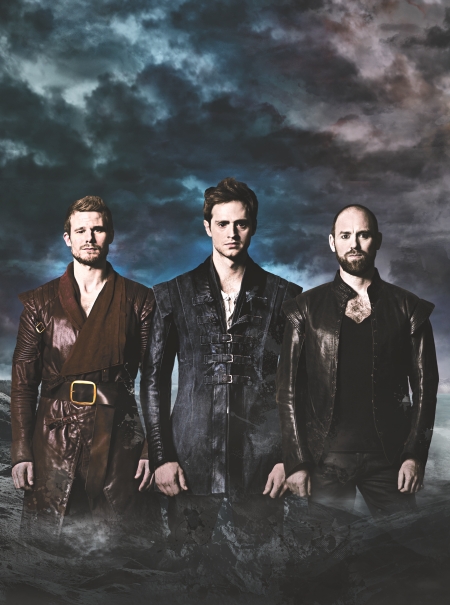
Who needs William Shakespeare or George R R Martin when we've got Rona Munro? By focusing on the lives of three lesser-known Scottish kings, Munro has tapped into the current zeitgeist for sword and sorcery, blood and guts, and heart-in-mouth political skulduggery made popular by Game of Thrones.

It's easy to compare The James Plays with Martin's world-conquering book and TV series (something the publicity does with glee), but the fact is, the stories told in these plays are scarier and more thrilling because it's all true. It actually happened. And like so many periods in British history, it's much more interesting than fiction.

Munro has chosen not to write biographies of these three men, but rather zoom in on a particular aspect or period in their life stories, and dramatise and expand upon it to astounding effect. The first play, James I: The Key Will Keep the Lock, is probably the most satisfying of the trilogy, telling the story of how James I went from being a boy prisoner of the English King Henry V, to crowned King of Scots. James learnt a lot from his upbringing in the English court, and wished to use this knowledge and education to reform Scotland. His ideas for reformed governance and taxation were modeled on what he'd seen working in England, but it took some convincing of the Scottish clansmen and lairds to adopt these new systems. Dictating that collected rents and taxes should pass to the royal household rather than the landowners was a highly controversial move, and made James few friends. His attempts to broker peace between the warring landowners was doomed from the start, but at least this idealist king tried, purely through a devotion to his homeland.

Wednesday, April 20, 2016

Cyrano de Bergerac (Theatr Clwyd, Mold)


Anybody who nose anything about Cyrano de Bergerac nose that the legendary bon viveur, poet and swordsman had a particularly protuberant proboscis. But woe betide anybody who happens to refer to this aspect of Cyrano's physiognomy, because he's especially sensitive on the subject.

There's a great scene when a visiting Norman baron continually interrupts one of Cyrano's lengthy dictums by forcing the word nose, or derivatives thereof, into the speech. Traditionally, Cyrano would slice this man in half with his rapier without a second thought, but this Norman baron so happens to be the apple of the eye of Cyrano's beautiful cousin Roxane, and so he has to keep that blade sheathed.

Edmond Rostand's Cyrano de Bergerac is a play purely about love, both proclaimed and unrequited. It is presented here by Theatr Clwyd as a farce, as well as a comedy, as well as a tragedy. It has its tongue firmly in its cheek, and Phillip Breen's production leans heavily on the humour, but this wayward lack of stylistic focus sometimes works against it. When it's funny, it does its job well, and the cast are obviously having a whale of a time. But when the play calls upon the audience to take these characters seriously, that earlier lack of sincerity can make it harder to engender genuine empathy. These people are amusing buffoons and histrionic cyphers, although despite this, there were still a few teary eyes in the house when the lights went up.

Sunday, April 17, 2016

Ceirw: A Savage Hart (Pontio, Bangor)


The ceaseless battle between Mankind and Mother Nature lies at the heart of the latest production from South Wales-based circus-makers Citrus Arts. But although the team from Citrus has been successfully creating circus-based shows since 2009, this time around they decided to build upon what they do so well by mixing circus with dance, theatre and an arresting aesthetic.

Ceirw: A Savage Hart is the result of years of research and development led by Bridie Doyle-Roberts and her husband James, and is directly inspired by the escapades of the Johnes family of Mid Wales, who owned the Hafod Estate during the 18th century. During research, the family's stories have been conflated into one representative figure, a cruel nobleman who becomes obsessed with his dominance over nature, symbolised by his tireless hunting of wild animals in the grounds of his estate, mounting their heads on the wall of his grand house.

Wednesday, March 16, 2016

Jumpy (Theatr Clwyd, Mold)


Philip Wright and Sara Stewart as Mark and Hilary

First staged at the Royal Court in London in 2011, Jumpy is a briskly modern comedy-drama which manages to address issues head-on without being preachy or patronising. April De Angelis's script is unapologetically funny - truly, laugh-out-loud hilarious - but through it all there's a vein of serious intent, which is to explore what it's like to be a middle-aged mother in the 21st century.

Hilary is 50 years old, married to the laconic Mark, has a stroppy 15-year-old daughter called Tilly, and is in a job teetering on redundancy. She has a best friend called Frances who has quite a different outlook on life to her, but nevertheless they complement one another. Jumpy is told from Hillary's point of view, so while there are other characters with issues and problems, and opinions and disasters, it's all seen through Hilary's lens. This means Sara Stewart is on stage for almost every second of the play.

Monday, March 14, 2016

There is a Place (Pontio, Bangor)


It seems odd that a show created to celebrate the opening of Bangor's Pontio arts complex should premiere more than four months after it actually opened. But then, Pontio isn't known for its punctuality - the £49m venue finally threw open its doors to the public in October 2015, 12 months later than first planned.

But better late than never, and the same goes for There is a Place, the brainchild of NoFit State Circus's artistic director Firenza Guidi, who has put together a truly mesmerising and magical show which brings together the Bangor community by including local schoolchildren and young performers on the bill.

The art of circus is a growing sector in the arts community, and it is NoFit State's intention to develop a regional base for circus skills at Pontio. Indeed, much of Pontio's inaugural programme has been circus-based, such as Ockham's Razor's Tipping Point and Citrus Arts' forthcoming A Savage Hart.

Thursday, March 10, 2016

Rambert Spring 2016 (Theatr Clwyd, Mold)

Frames. Pic: Tristram Kenton

It's a question choreographers must be asked all too often: does an audience need to be aware of the inspiration for a piece of work in order for them to understand it, or get the most out of it? Can an observer come in to a dance piece completely cold and pick up what it's about just from watching it?

Kim Brandstrup, choreographer of Transfigured Night, believes firmly that "there is nothing you need to know in advance" of seeing this piece. He says that the audience is "watching people, human beings who will take you on a journey".

I disagree. If you reduce what dance is to merely human beings moving about, albeit in a beautiful way, then what you're essentially left with is legendary choreographer Merce Cunningham's pioneering yet challenging philosophy of discarding narrative and intent, and simply dancing for dancing's sake. Cunningham may have meant it was the performer who dances without intent, but without understanding of a choreographer's intent, surely the audience is being placed in that same unenlightened position.

Saturday, February 27, 2016

Iphigenia in Splott (Galeri, Caernarfon)


Let's get it out of the way first: Sophie Melville is remarkable in this play. It's a one-act, one-woman monologue which has a blistering story to tell, with twists and turns, shocks and surprises, joy and tragedy, just like your average episode of EastEnders.

But Melville doesn't just perform the monologue; she doesn't merely act out the role of Effie. Melville is Effie, she becomes her. With so much theatre, and particularly monologues, you can sense the performers acting. It's a largely unavoidable characteristic of theatre, the shared conceit between performer and audience that this is all artifice, it's pretend, make-believe. "We've paid good money to come and watch you mess about on stage for two hours."

But not when you watch Iphigenia in Splott. Because the performance is so magnetic, and the writing so truthful, that you're sucked into the fiction yourself, helped enormously by Effie's direct address to the audience at the start of the piece. It includes you, accuses you, and involves you. I was there with Effie in the Great Western pub, I was there with her in the bedroom with Lee, and I was certainly there with her in the ambulance. Boy, was I there!